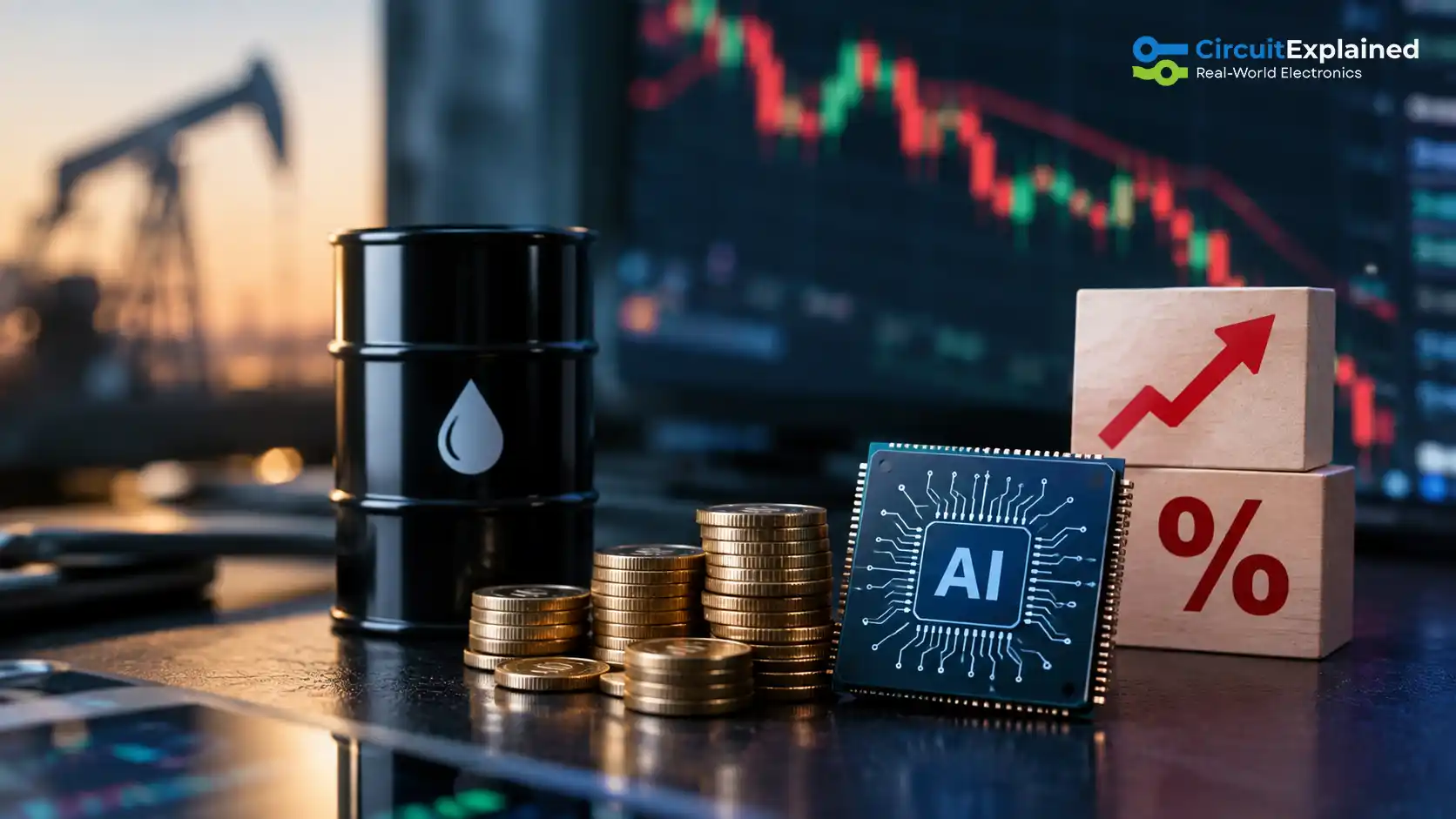
Global markets began the week under pressure as investors reassessed both the speed of artificial-intelligence development and the macroeconomic environment supporting technology valuations. Reuters reported that U.S. stock futures fell on 14 September, with Nasdaq futures down roughly 1.6%, while AI-linked shares declined across the United States, Europe, and Asia. The move followed public calls from leaders at major AI companies for a slower development pace because of safety concerns. At the same time, oil prices rose more than 3% after new attacks affected Saudi energy infrastructure and shipping routes in the Middle East. [Reuters] +2
The immediate market reaction does not prove that AI demand is weakening. It does show that the sector is no longer insulated from ordinary financial-market constraints. Higher oil prices can raise inflation, while higher inflation can delay interest-rate cuts or encourage further tightening. Higher rates reduce the present value of long-dated growth companies and increase the financing cost of building data centers, power systems, and semiconductor capacity.
The safety debate introduces a second uncertainty. If governments or companies impose stricter controls on frontier-model development, spending could shift from rapid model scaling toward evaluation, security, governance, and safer deployment. That would not eliminate AI investment; it could redirect part of it toward compliance, inference efficiency, cybersecurity, and enterprise applications with clearer controls.
For electronics and PCB businesses, the practical message is to focus on the physical bottlenecks that remain valuable under multiple scenarios. High-speed boards, power distribution, cooling, optical interconnects, testing and reliability engineering are needed whether AI growth is fast or more regulated. These markets are less dependent on a single model-release cycle.
For investors and business owners, the distinction between revenue growth and capital intensity becomes more important. Companies with large backlogs but weak cash conversion may be vulnerable if customers delay projects. By contrast, suppliers with diversified customers, recurring service revenue, and demonstrable productivity gains may be more resilient.
The main conclusion is balanced: AI remains a major technology and infrastructure trend, but the market is entering a more selective phase. Future winners will need more than impressive benchmarks. They will need reliable deployment, manageable energy costs, strong governance, recurring customers, and cash flow that can withstand a tougher macroeconomic environment.