

 By
By LEDs are everywhere, in power indicators, home lighting, cars, TVs, and DIY electronics projects. But one common beginner mistake is connecting an LED directly to a battery without a resistor for LED protection. That usually burns the LED instantly.
In this guide, I’ll explain:
- What an LED driver circuit is
- Why a led resistor is important
- How to calculate the correct resistor value
- How to safely use LEDs in real projects
- LED resistor calculation step-by-step
What Is an LED Driver Circuit?
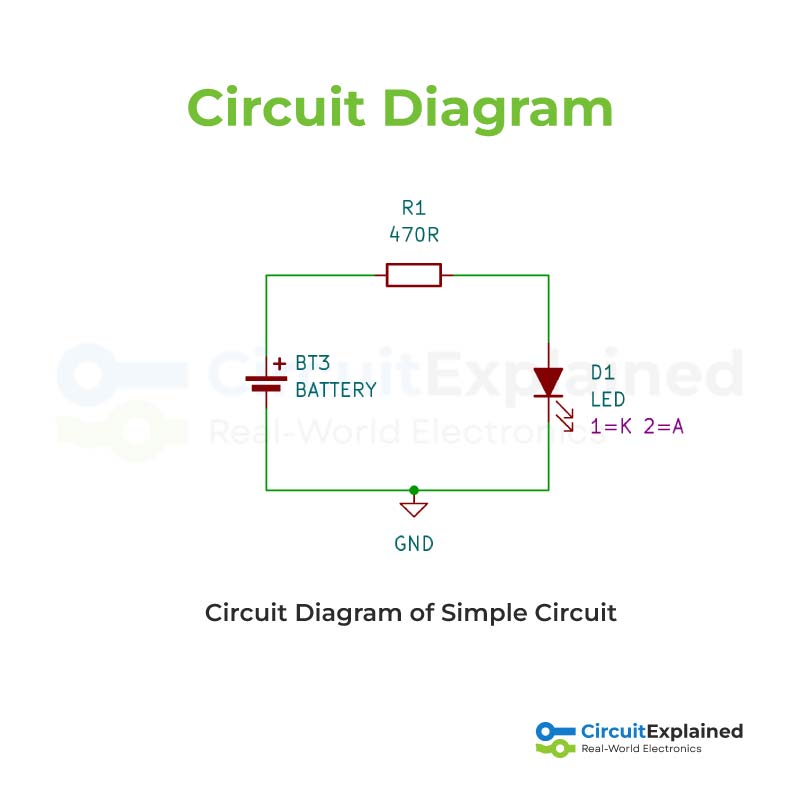
An LED driver circuit is a circuit that safely powers an LED.
LEDs are current-sensitive devices. That means they don’t limit current by themselves. If you connect them directly to a power supply, they will draw too much current and burn out.
A basic LED driver circuit usually contains:
- Power supply (battery or DC adapter)
- LED
- Current limiting resistor (LED light resistor)
In simple projects, the led light resistor is the most common and easiest solution.
Why Do LEDs Need a Resistor?
LEDs have:
- A fixed forward voltage (Vf)
- A maximum forward current (If)
If the current goes above the safe limit, the LED will fail.
That’s why using resistors with LEDs is critical. The resistor controls how much current flows through the LED.
This resistor is often called:
- led resistor
- resistor for led
- led light resistor
- led bulb resistor
- led load resistor
All mean the same thing: a resistor that protects the LED.
Basic LED Driver Circuit (Step-by-Step)
Let’s build a simple LED driver circuit.
Step 1: Gather Components
- 9V battery (or any DC supply)
- LED
- Resistor
- Breadboard or wires
Step 2: Understand LED Specifications
A typical red LED:
- Forward Voltage (Vf) = 2V
- Forward Current (If) = 20mA (0.02A)
Different colors have different voltages:
- Red: ~2V
- Green: ~2.2V
- Blue/White: ~3V to 3.3V
Step 3: LED Resistor Calculation
We use Ohm’s Law:
Where:
- R = resistor value
- Vsupply = power supply voltage
- VLED = LED forward voltage
- I = LED Current
Suggestion learning Ohm’s Law in details
Example Calculation
Power supply = 9V
LED forward voltage = 2V
LED current = 20mA = 0.02A
So we use the nearest standard value: 330Ω or 360Ω.
LED Resistor Calculator (How to Do It Easily)
You can use a led resistor calculator, many available online.
You simply enter:
- Supply voltage
- LED forward voltage
- Desired LED current
And it gives you the resistor value.
Many beginners search for:
- led resistor calculator
- led light resistor calculator
But now you know how to calculate it manually too.
What Is an LED Load Resistor?
A led load resistors are often used in automotive applications.
Example:
When replacing halogen bulbs with LEDs in cars, the car may show an error. A led load resistor is added to simulate the original bulb’s power usage.
It is NOT for current limiting in this case, it is for load simulation.
LED Blinker Resistor
If you install LED turn signals in a car, you might notice fast blinking.
That’s because LEDs use less current than old bulbs.
A led blinker resistor fixes this by adding extra load to match the original bulb’s current.
LED Bulb Resistor
A led bulb resistor is usually used:
- In automotive lighting
- In indicator systems
- When replacing incandescent bulbs
It helps balance current and prevent flickering or error codes.
What Happens If You Don’t Use a Resistor?
If you skip the resistor for LED:
- LED overheats
- LED becomes very bright for a second
- LED burns out permanently
That’s why using resistors with LEDs is one of the most important rules in electronics.
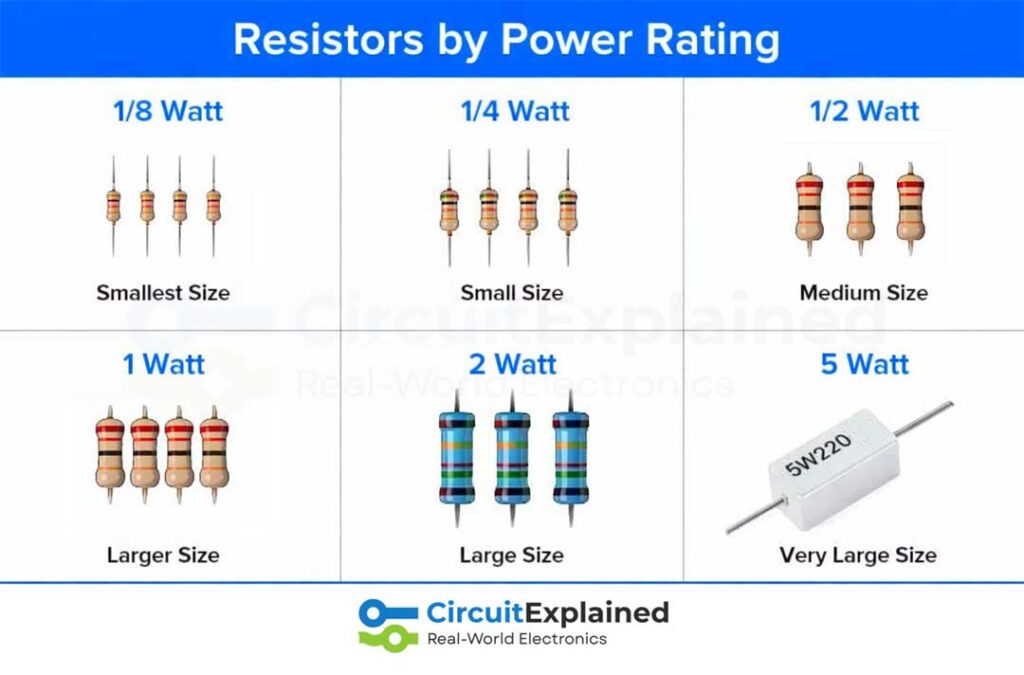
Power Rating of the Resistor
You also need to check resistor power.
Power formula:
Or
For our example:
So a 1/4W (0.25W) resistor is safe.
Multiple LEDs in Series
If you connect multiple LEDs in series:
Total LED voltage = Sum of all LED forward voltages.
Example:
Three white LEDs (3V each)
Total = 9V
If supply = 12V
Resistor voltage = 12V – 9V = 3V
Then calculate resistor normally.
Suggestion Learning
Common Beginner Mistakes
- Connecting LED directly to battery
- Using too small resistor value
- Ignoring resistor power rating
- Mixing up LED polarity
Summary
An LED driver circuit can be very simple.
For beginners, the easiest method is:
Power Supply → Resistor → LED
Remember:
- Always use a led resistor
- Calculate properly using Ohm’s Law
- You can use a led resistor calculator
- Choose correct resistor power rating
- Understand difference between led load resistor and current limiting resistor