

 By
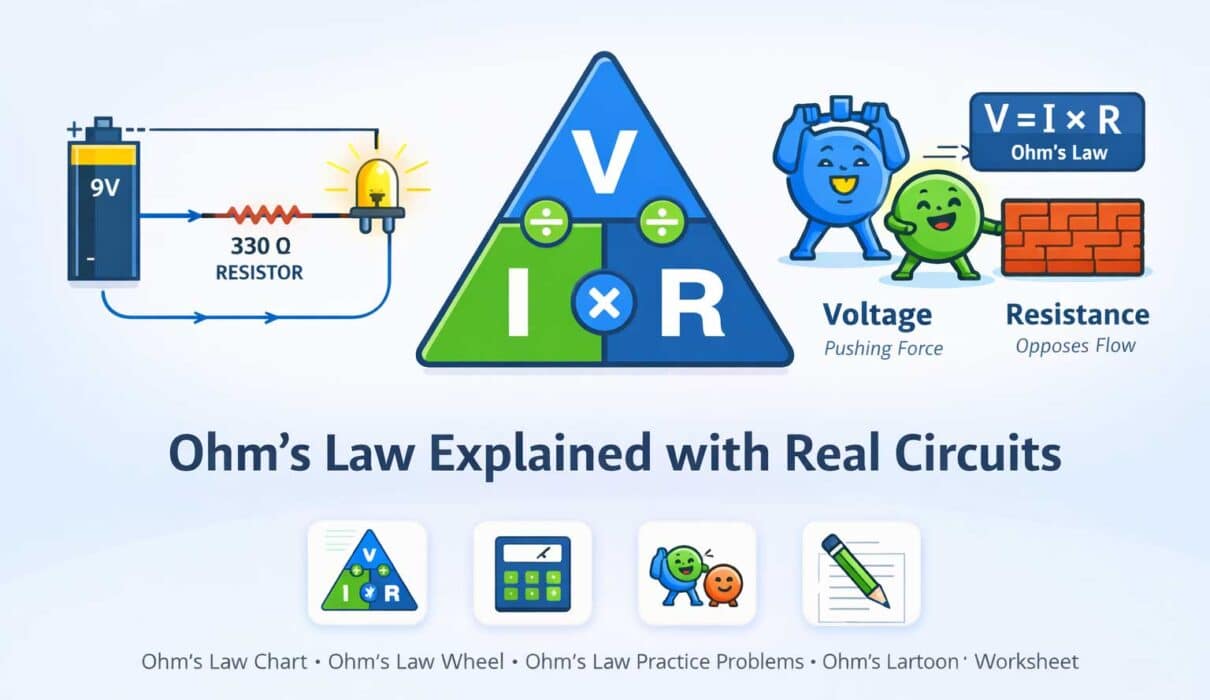
By Ohm’s Law is one of the first and most important rules in electronics.
If you understand it well, reading circuits, fixing problems, and designing simple electronics becomes much easier.
In this article, we’ll explain Ohm’s Law using real circuits, simple examples, and visual tools—no heavy math, no confusion.
What Is Ohm’s Law?
Ohm’s Law explains the relationship between voltage (V), current (I), and resistance (R).
The basic formula of ohm’s law is:
V = I × R
This means:
- Voltage pushes current
- Resistance limits current
- Current depends on both voltage and resistance
Ohm’s Law Explained with a Real Circuit
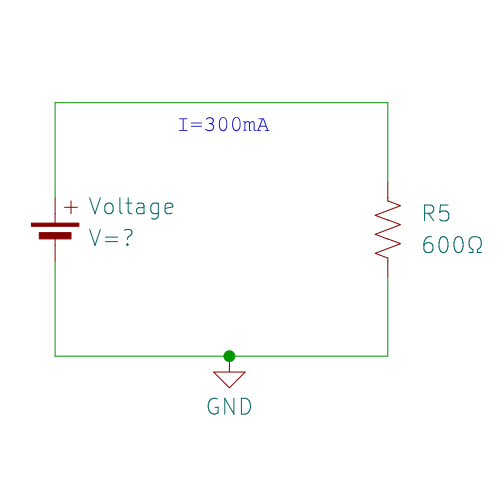
Imagine a simple circuit with:
- A battery (voltage source)
- A resistor
- An LED
If you increase the voltage, more current flows.
If you increase the resistance, less current flows.
This is Ohm’s Law in action, not just a formula, but something happening in real circuits.
How to Choose the Right Resistor for an LED
This is one of the most practical uses of Ohm’s Law.
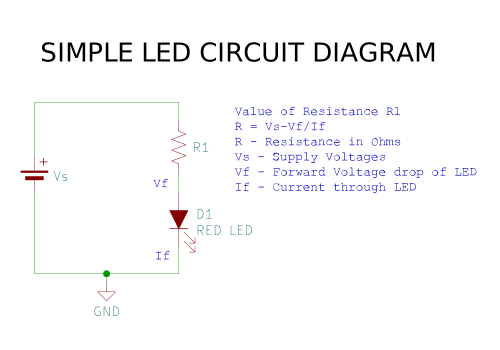
You need:
- Supply voltage (Vs)
- LED forward voltage (Vf)
- LED current (If)
Example:
- Supply voltage = 5V
- LED forward voltage = 2V
- LED current = 20mA (0.02A)
Step 2: Calculate Resistor Voltage
V = Vs − Vf
V = 5 − 2 = 3V
Step 3: Apply Ohm’s Law
R = V ÷ I
R = 3 ÷ 0.02 = 150Ω
Step 4: Choose the Nearest Standard Value
Use a 150Ω resistor.
This prevents LED damage and ensures long life.
Using the Ohm’s Law Chart
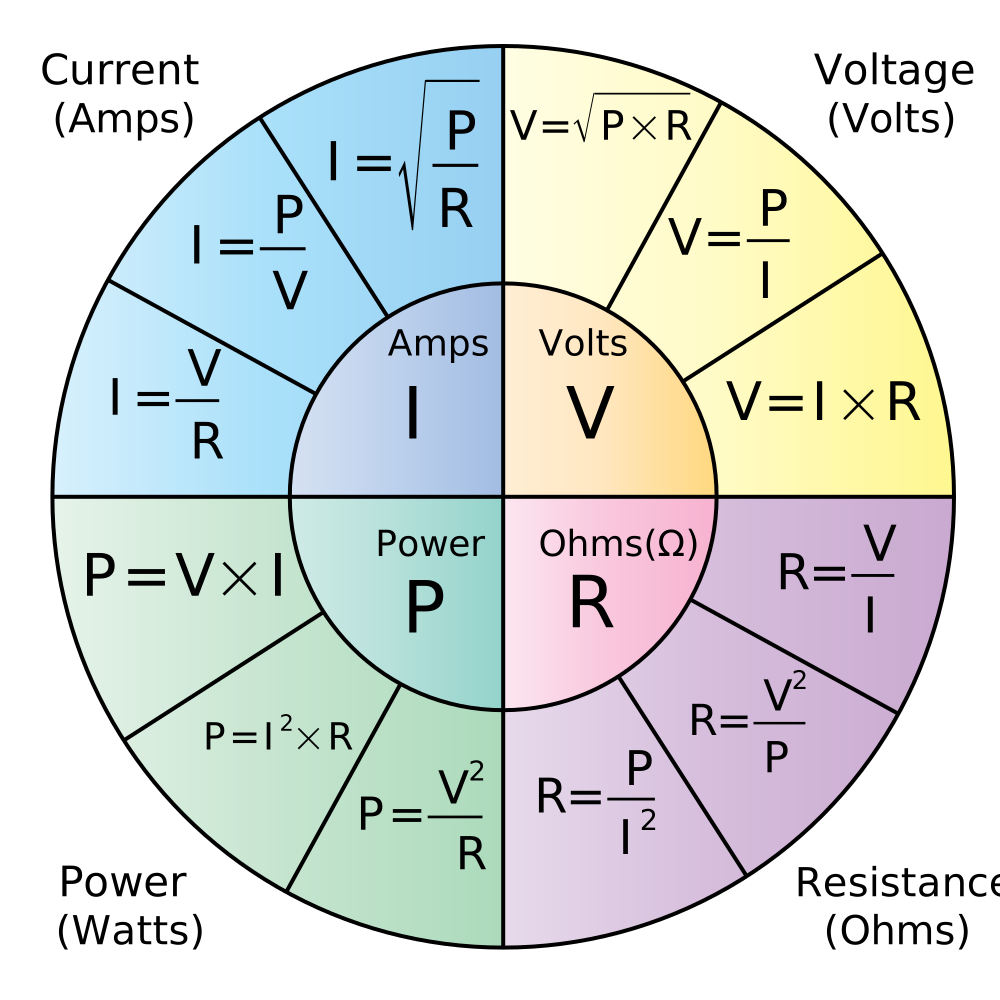
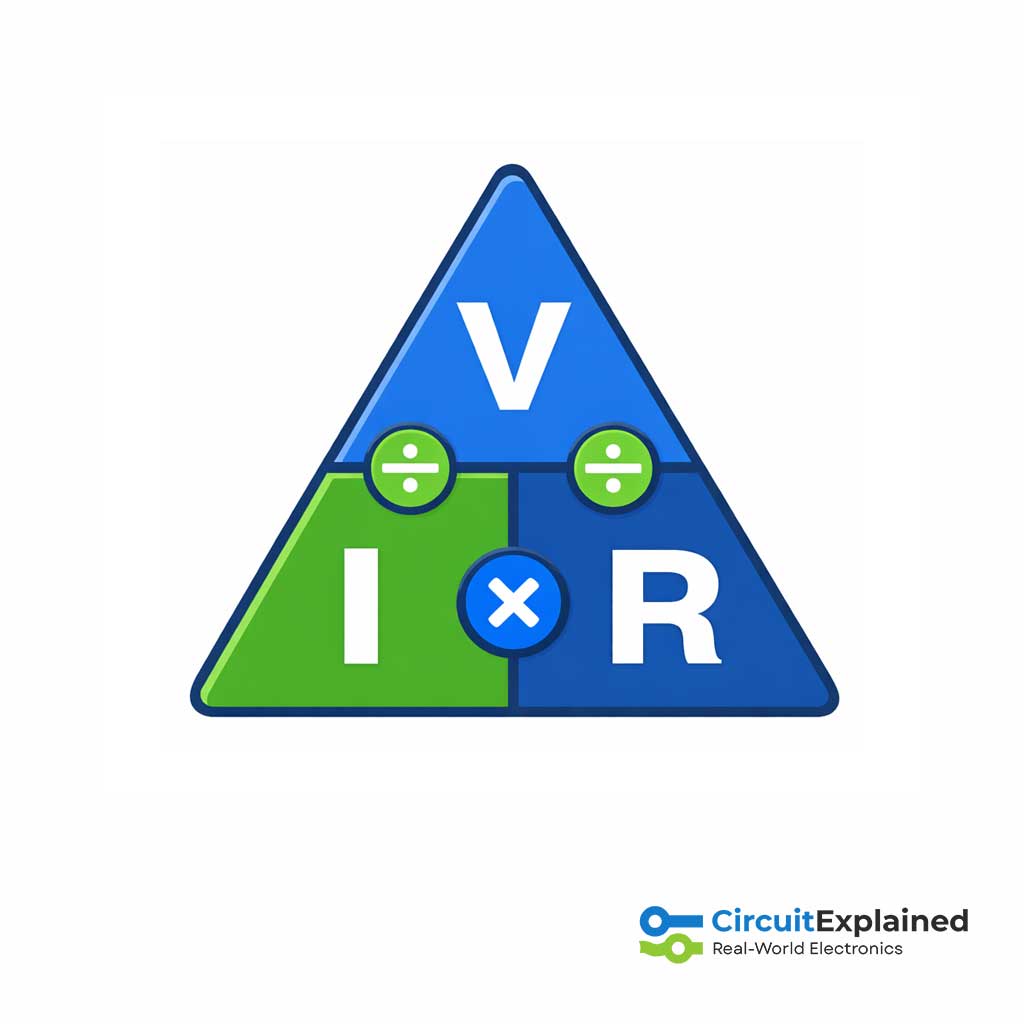
An Ohm’s Law chart or Ohm’s Law wheel is a visual tool that helps you quickly find formulas without memorizing them.
Examples:
- To find current → I = V ÷ R
- To find resistance → R = V ÷ I
These charts are great for beginners and are often used in labs and classrooms.
Ohm’s Law Cartoon (Easy Way to Remember)

Many beginners learn Ohm’s Law using cartoons or water-flow analogies:
- Voltage = water pressure
- Current = water flow
- Resistance = pipe size
An Ohm’s Law cartoon makes the concept easy to remember and fun to learn.
Ohm’s Law Worksheet (Practice Helps!)
Using an Ohm’s Law worksheet is one of the best ways to master the topic. Worksheets usually include:
- Fill-in-the-blank questions
- Simple calculations
- Real circuit examples
You can practice and then check your answers using an Ohm’s Law chart.
Where Ohm’s Law Is Used
Ohm’s Law is used in:
- LED resistor selection
- Power supply design
- PCB circuit analysis
- Arduino and ESP32 projects
You’ll see it again and again in electronics.
Ohm’s Law Practice Problems (Simple Examples)
Example 1
A 9V battery is connected to a 300Ω resistor.
I = V ÷ R
I = 9 ÷ 300 = 0.03A (30mA)
Example 2
A circuit has 2A of current and 6V.
R = V ÷ I
R = 6 ÷ 2 = 3Ω
Practicing Ohm’s Law practice problems like these helps you build confidence quickly.
Learn More on CircuitExplained
If you’re just starting out, these articles will help:
- Calculators
- How to Read a Circuit Diagram (Beginner-Friendly Guide)
- Series Circuit vs Parallel Circuit: What’s the Difference?
- What Is Ground in Electronics?
Final Thoughts
Ohm’s Law is simple, powerful, and essential.
With charts, real circuits, and practice problems, it becomes easy to understand, even if you’re a complete beginner.
1 Comment