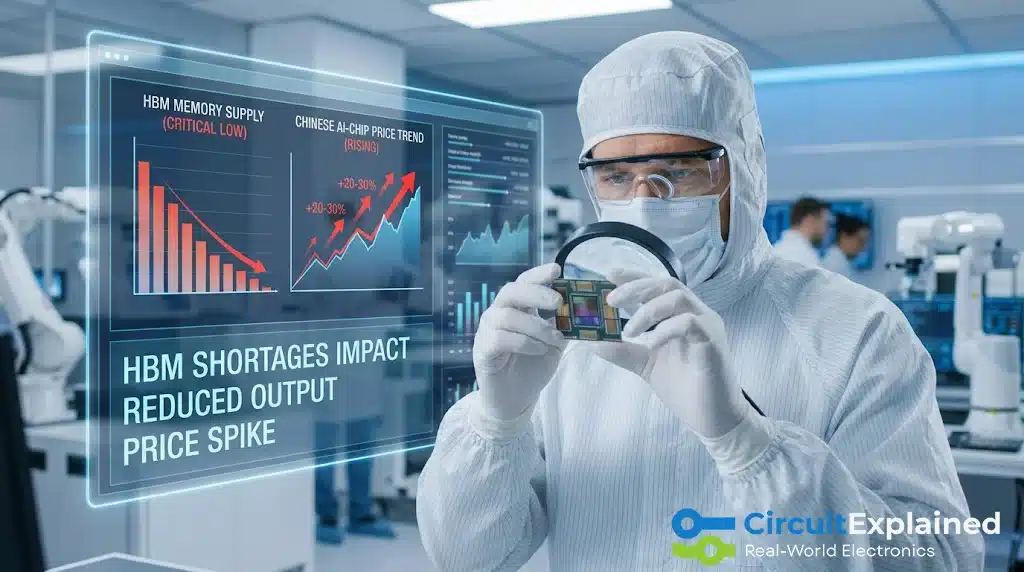
The global artificial-intelligence industry is facing a bottleneck that sits between chip design and final deployment: high-bandwidth memory, or HBM. Chinese AI-chip companies are now raising prices as they compete for limited supplies of this specialized memory. Reuters reports that Huawei increased the price of its upcoming Ascend 950DT accelerator card to more than 250,000 yuan, representing an increase of roughly 20% to 50% from earlier quotes. Cambricon has reportedly raised prices for its next-generation 690 chip by approximately 20% to 30%. [Reuters]
HBM is important because modern AI accelerators must move enormous volumes of data between processing cores and memory. Traditional memory architectures can create a bottleneck, limiting performance even when the processor itself is powerful. HBM solves part of this problem by stacking memory dies vertically and connecting them through advanced packaging technologies. The result is very high bandwidth in a compact footprint, but manufacturing is technically difficult and capacity is limited.
The shortage is particularly significant for China. Export controls have restricted access to some advanced foreign semiconductors and memory products, forcing Chinese companies to develop domestic alternatives while also competing for scarce components through expensive procurement channels. Higher HBM costs raise the price of complete AI systems and make it more difficult for Chinese accelerator makers to match the economics of global competitors.
The impact extends far beyond chip companies. HBM demand supports advanced packaging, interposers, substrates, memory testing, thermal management, and high-speed PCB design. System engineers must manage signal integrity, power delivery, heat removal, and mechanical reliability across the chip, package, and board. This is creating opportunities for specialized suppliers that can improve yield or reduce the amount of memory required for a given workload.
There is also a financial risk. Strong prices encourage memory manufacturers and packaging companies to invest aggressively in new capacity. If supply expands faster than AI demand, memory prices could fall sharply, repeating the cyclical pattern common in the semiconductor industry. For businesses and investors, the most useful indicators are customer qualifications, production yield, allocation agreements, and long-term demand, not only current spot prices.
The main lesson is that AI competitiveness depends on the entire hardware stack. Processor architecture matters, but so do memory availability, packaging quality, PCB engineering, and thermal design. As AI systems grow larger, the companies that control these supporting technologies may capture an increasing share of the industry’s value.