Analog Devices’ planned $1.35 billion acquisition of Alif Semiconductor is a useful signal that the next phase of artificial intelligence will be shaped not only by large cloud models but also by intelligence embedded directly into physical products. ADI is a major supplier of sensing, signal-processing, and power-management technologies used in industrial, automotive, communications, and healthcare systems. Alif contributes processors designed for low-power embedded applications with AI and sensor-fusion capabilities. [Reuters]
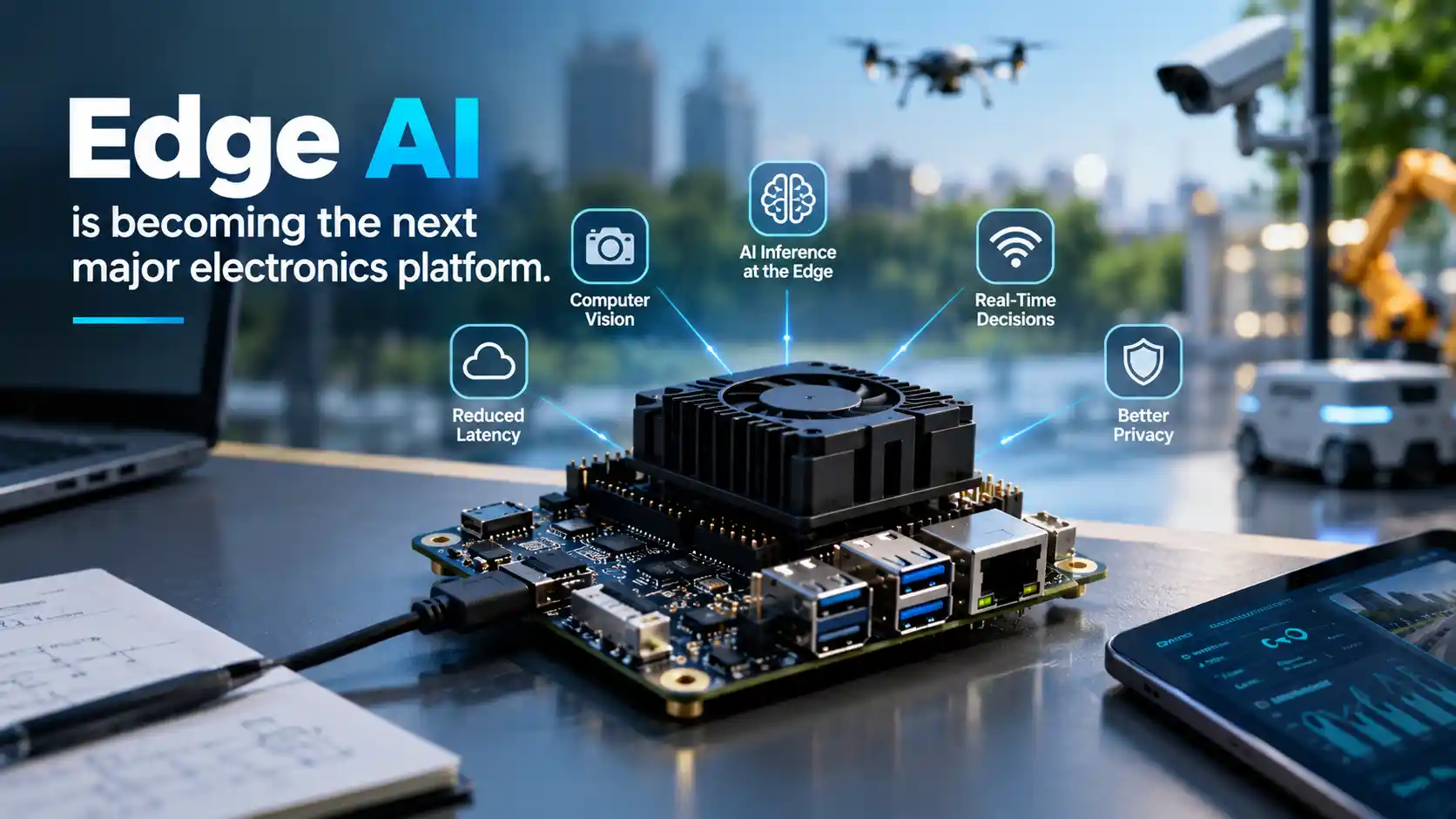
The factual strategic logic is straightforward: combining sensing with local computation can allow machines to analyze data and respond immediately, without sending every signal to a remote cloud. That matters in applications such as robotics, industrial monitoring, medical equipment, drones, and vehicles, where latency, privacy, connectivity, and energy consumption are important constraints. Local processing can also reduce bandwidth costs and improve resilience when networks are unreliable.
The broader market implication is that “AI hardware” will increasingly include microcontrollers, embedded processors, sensors, power-management ICs, connectivity chips, and software tools, not just GPUs. This expands the opportunity for electronics designers and system integrators. A factory motor-control unit, for example, may combine vibration sensing, anomaly detection, local decision-making, and secure communications on one compact board. A medical or automotive product may need real-time sensor fusion under strict safety and power limits.
There are also risks. Acquisitions do not automatically create successful products. ADI will need to integrate Alif’s software ecosystem, support developers, win design-ins, and prove long-term product availability to industrial customers. Embedded markets also have long qualification cycles, so revenue may take years to scale.
For PCB and electronics businesses, the practical message is clear: future designs will require closer coordination between analog sensing, digital processing, power integrity, RF or wired connectivity, and thermal management. Engineers who can move across those boundaries will be well positioned as intelligence becomes a standard feature of physical equipment rather than a capability reserved for data centers.