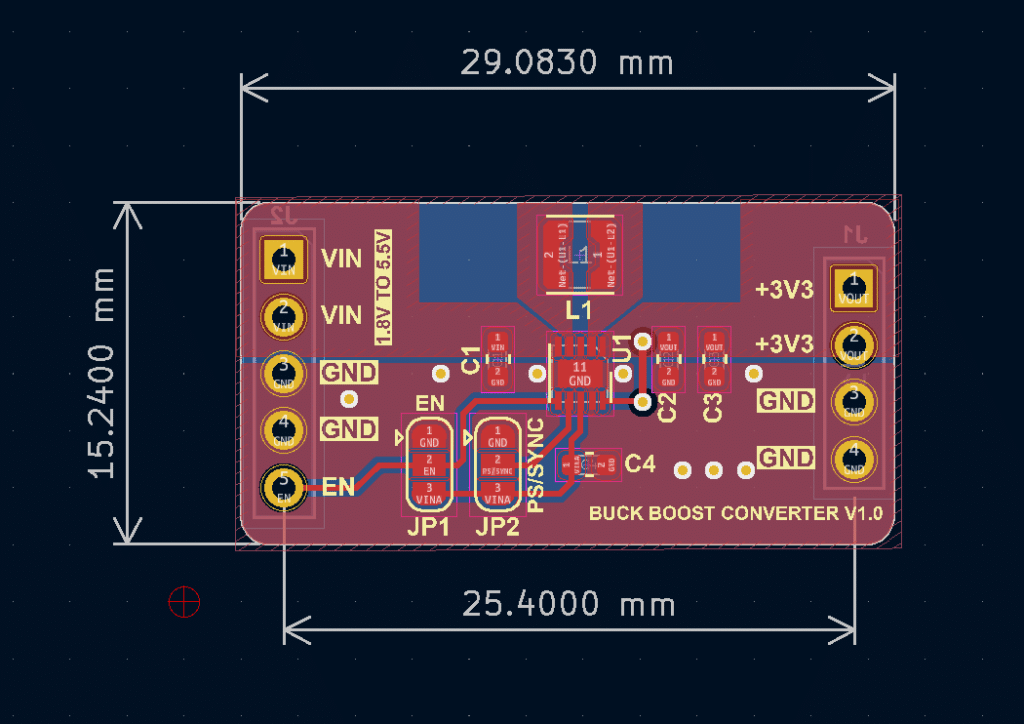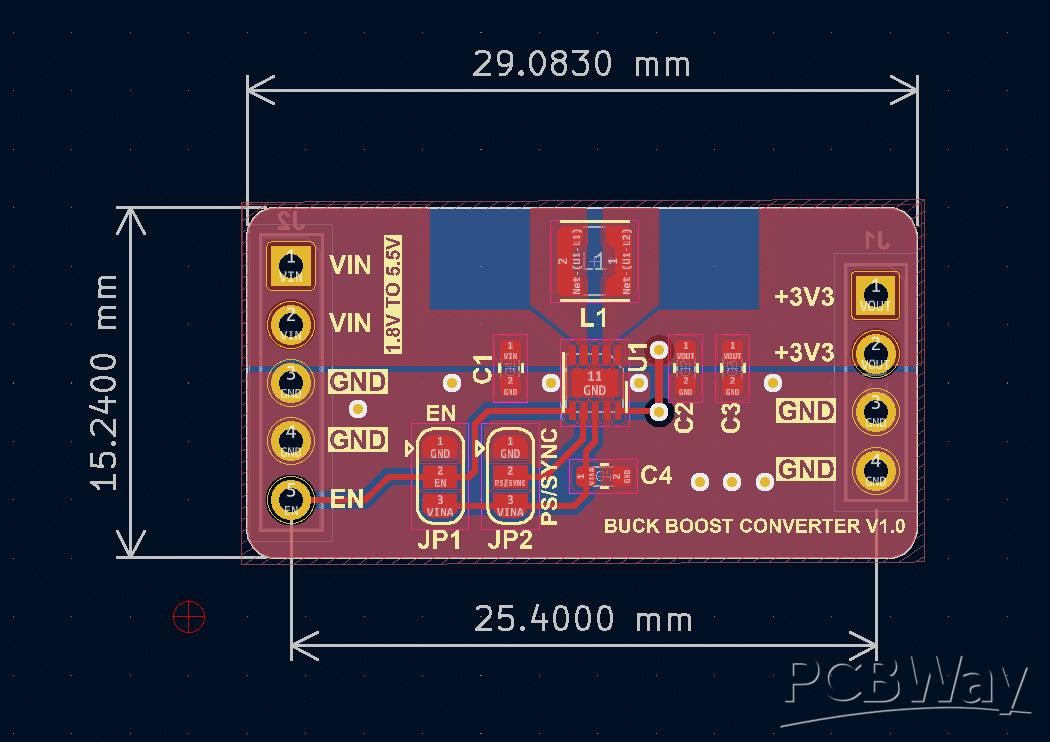
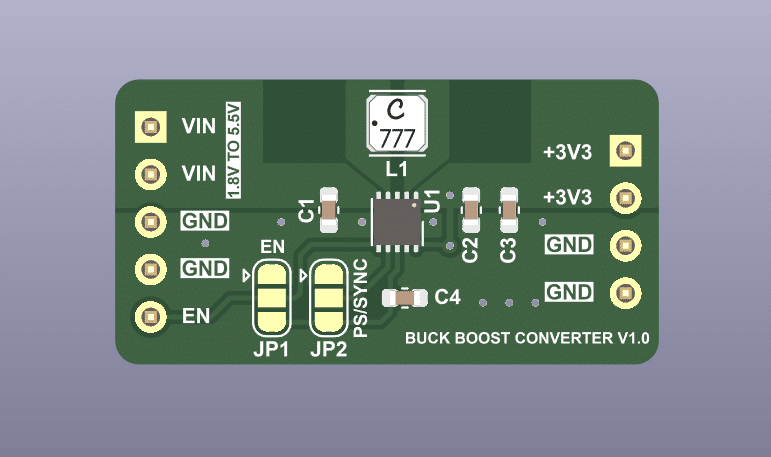
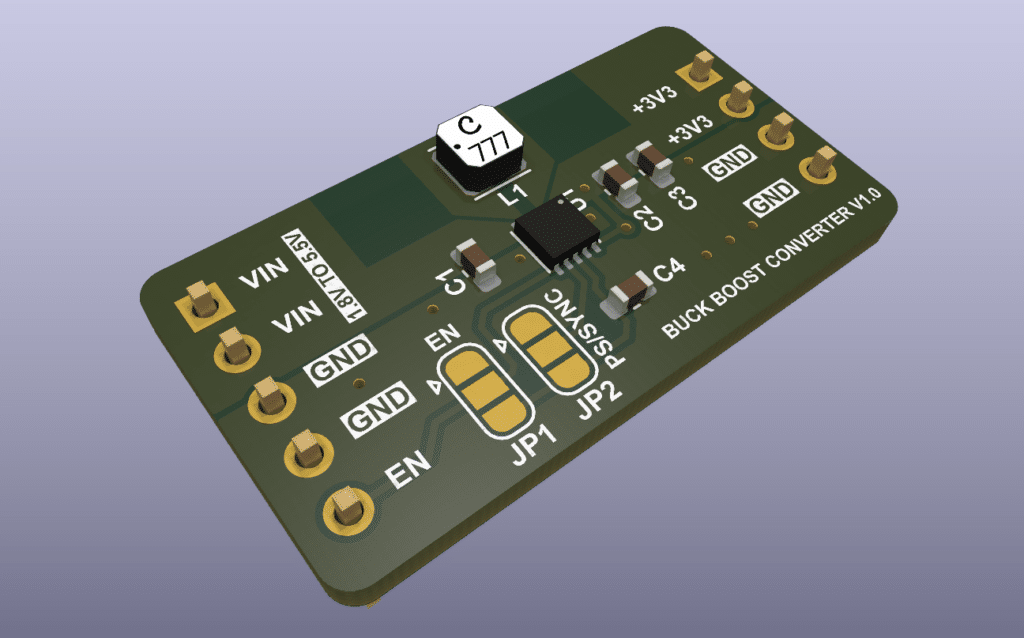

Components
| Sr. # | Component Part Number | Manufacturer | Quantity |
|---|---|---|---|
| 01 | TPS63031DSKT | Texas Instruments | 01 |
| 02 | GRM188R60J106KE47J | Murata Electronics | 03 |
| 03 | GCM188R71H104KA57J | Murata Electronics | 01 |
| 04 | LPS3015-152MRC | CoilCraft | 01 |
| 05 | TS-104-T-AA | Samtec Inc. | 01 |
| 06 | TS-105-T-A | Samtec Inc. | 01 |
Tools, APP software used, etc.
| Sr. # | Software / Tool Name | Link to Website |
|---|---|---|
| 01 | KiCad | https://www.kicad.org |
Description
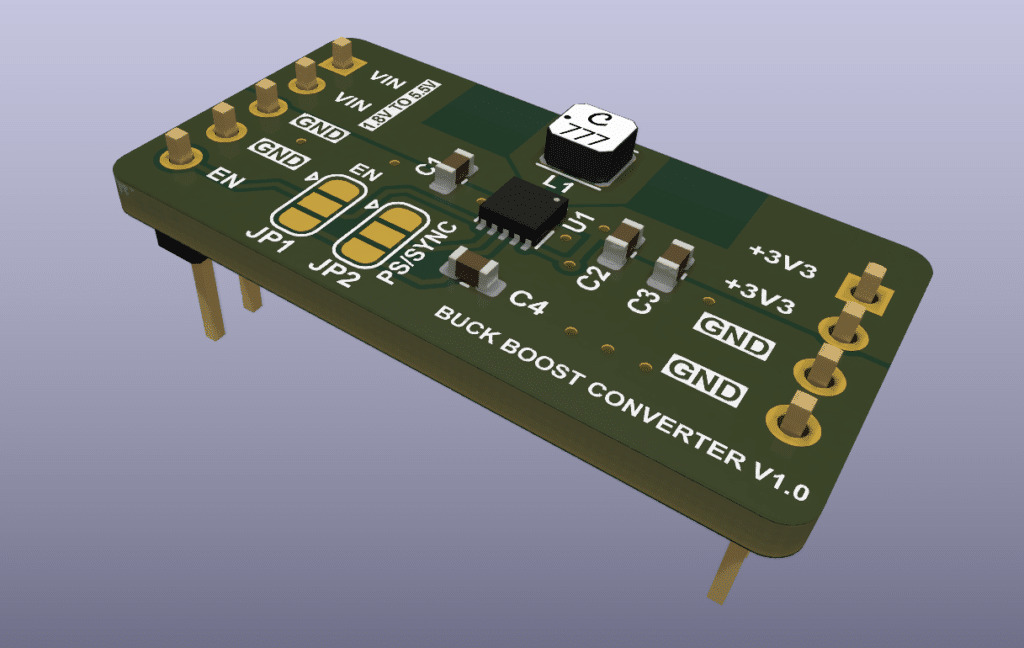
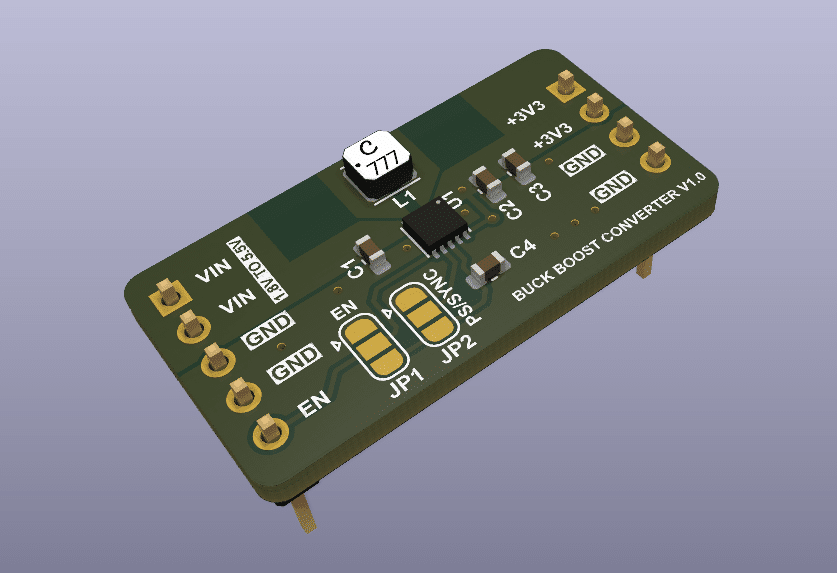
The TPS6303x devices provide a power supply solution for products powered by either a two-cell or three-cell alkaline, NiCd or NiMH battery, or a one-cell Li-ion or Li-polymer battery. Output currents can go as high as 600 mA while using a single-cell Li-ion or Li-polymer battery, and discharge it down to 2.5 V or lower. The buck-boost converter is based on a fixed-frequency, pulse width modulation (PWM) controller using synchronous rectification to obtain maximum efficiency. The converter enters power-save mode at low-load currents to maintain high efficiency over a wide load current range. The power-save mode can be disabled, forcing the converter to operate at a fixed switching frequency. The maximum average current in the switches is limited to a typical value of 1000 mA. The output voltage is programmable using an external resistor divider or is fixed internally on the chip. The converter can be disabled to minimize battery drain. During the shutdown, the load is disconnected from the battery.

Features
- Input voltage range: 1.8 V to 5.5 V
- Fixed output voltage options from 1.2 V to 5.5 V
- Up to 96% efficiency
- 800 mA Output current at 3.3 V in step-down mode (VIN = 3.6 V to 5.5 V)
- Up to 500-mA output current at 3.3 V in boost mode (VIN > 2.4 V)
- Automatic transition between step-down and boost mode
- Device quiescent current less than 50 μA
- Power-save mode for improved efficiency at low-output power
- Forced fixed-frequency operation and synchronization possible
- Load disconnect during shutdown
- Overtemperature protection
Applications
All two-cell and three-cell alkaline, NiCd, or NiMH, or single-cell Li battery-powered products
- Smartphone
- Portable media player
- IP network camera
- Blood glucose monitor
- Portable data terminal
Schematic and Layout