
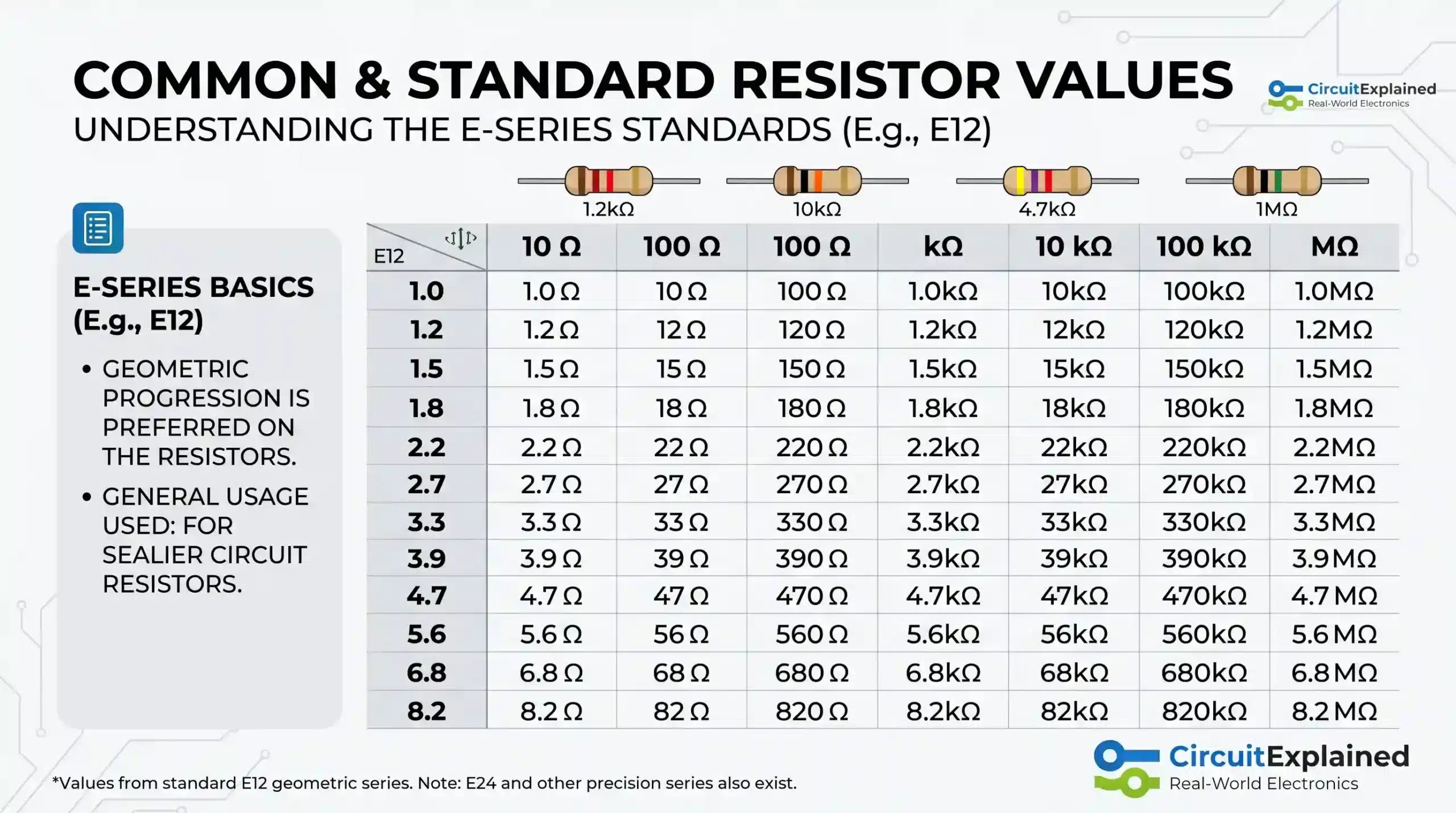
Resistors are not made in every possible value. Instead, manufacturers follow standardized series called E-series, which define preferred values based on tolerance.
What Are E-Series Values?
The E-series system organizes resistor values in a logarithmic scale per decade (e.g., 10Ω–100Ω, 100Ω–1kΩ). Each series corresponds to a tolerance level.
Common E-Series
- E6 (±20% tolerance) → 6 values per decade
- E12 (±10% tolerance) → 12 values per decade
- E24 (±5% tolerance) → 24 values per decade
- E48, E96, E192 → Higher precision (±2%, ±1%, and tighter)
Standard Resistor Values (E12 Series – Most Common)
These are widely used in general electronics:
Base Values (One Decade)
10, 12, 15, 18, 22, 27, 33, 39, 47, 56, 68, 82
How to Use Them
You multiply these base numbers by powers of 10 to get other values:
- 10Ω, 100Ω, 1kΩ, 10kΩ
- 22Ω, 220Ω, 2.2kΩ, 22kΩ
- 47Ω, 470Ω, 4.7kΩ, 47kΩ
E24 Series (More Precise – ±5%)
Includes additional intermediate values:
10, 11, 12, 13, 15, 16, 18, 20, 22, 24,
27, 30, 33, 36, 39, 43, 47, 51, 56, 62,
68, 75, 82, 91
Why These Values Exist
These values ensure:
- Easy manufacturing
- Consistent availability
- Coverage of all ranges without needing infinite options
Instead of exact values, engineers pick the closest standard value that fits the design.
Final Thoughts
Standard resistor values simplify circuit design and production. Once you memorize the E12 series, you can quickly estimate and select resistors for most applications.