
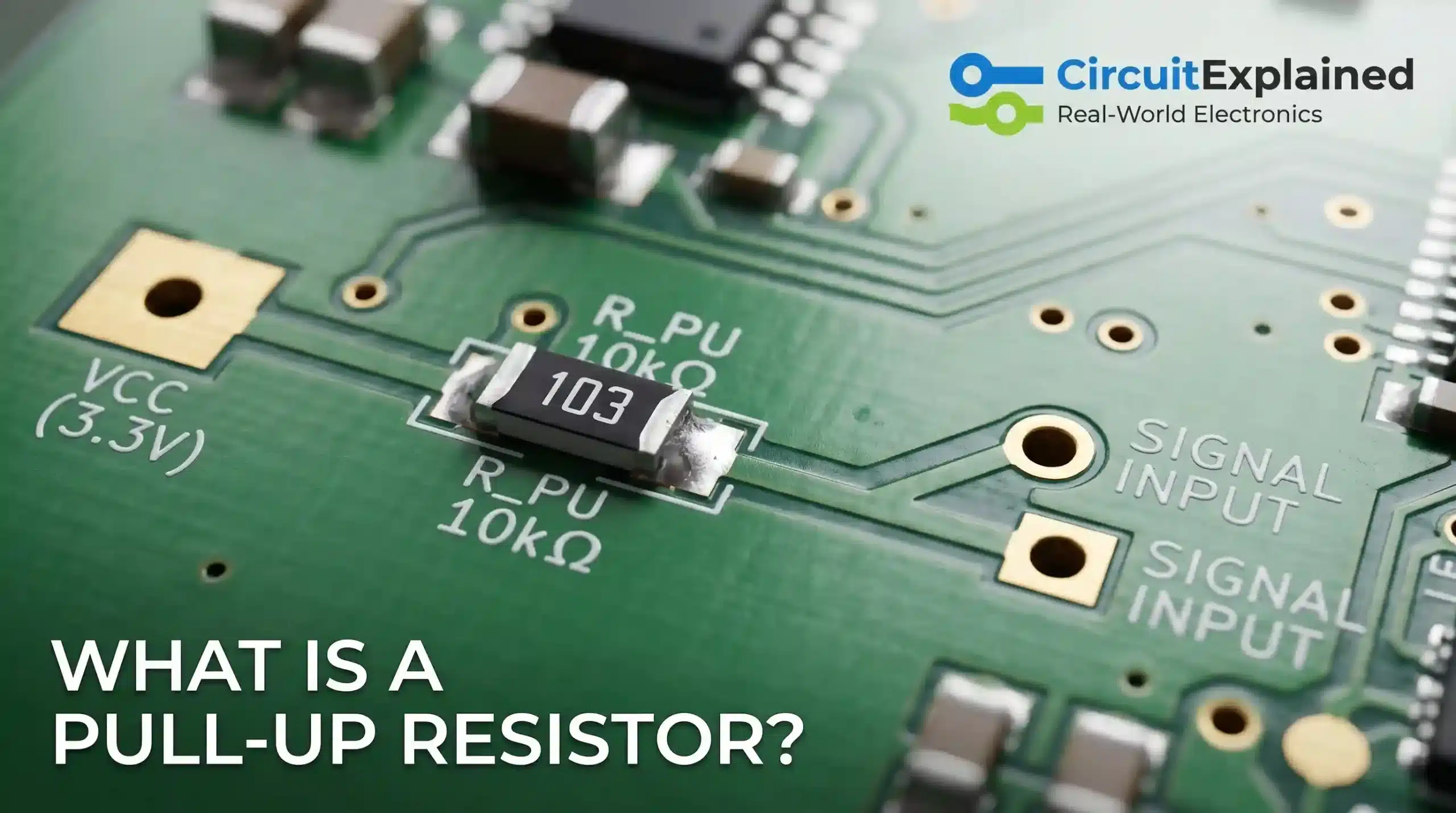
A pull up resistor is a small but important component in digital electronics. It connects a signal line to a positive voltage source, usually VCC. This keeps the signal at a stable HIGH level when no device is controlling it.
It helps prevent floating inputs. Floating signals can cause random and unwanted behavior in circuits.
Why Pull-Up Resistors Are Important
Digital inputs must always have a clear state. They should be either HIGH or LOW at all times. When a pin is left open, it can pick up noise from the surroundings.
This noise can make the signal unstable. The system may behave unpredictably.
A pull-up resistor fixes this issue. It keeps the input HIGH by default. This makes the circuit more reliable and easier to control.
How It Works
A pull-up resistor connects between the input pin and the supply voltage. When no switch or device is active, the resistor pulls the signal HIGH.
When a switch closes, it connects the line to ground. This forces the signal LOW. The resistor limits current and protects the circuit.
Common Applications
Pull-up resistors are used in many circuits. They are common in microcontrollers and logic gates. They are also used in communication lines like I2C.
You will often see them in push-button circuits. They ensure a stable HIGH signal until the button is pressed.
Pull-Up vs Pull-Down Resistor
A pull-up resistor sets the default state to HIGH. A pull-down resistor sets it to LOW. Both prevent floating inputs and improve signal stability.
Final Thoughts
A pull-up resistor may look simple, but it plays a key role. It keeps signals stable and circuits reliable. It is a basic building block in modern electronics.